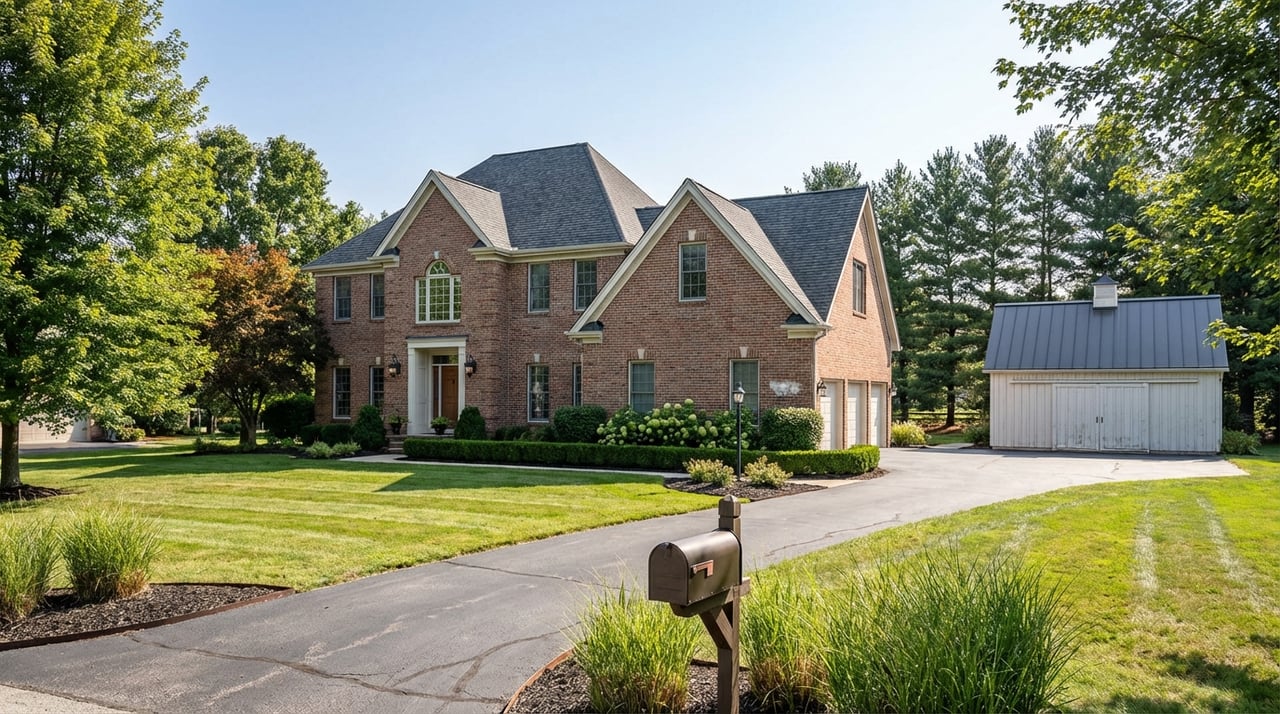
What would a 1 percent interest rate change do to your budget in Darnestown or anywhere upcounty along the I‑270 corridor? If you are shopping for more space, acreage, or an easier commute to Bethesda or Rockville, the monthly payment is often the deciding factor. In this guide, you will see exactly how rates move your payment and your price point so you can plan with confidence. Let’s dive in.
Upcounty market reality: why rates matter
Prices and inventory vary from Darnestown to Germantown to Rockville, but one constant is this: the interest rate on your loan drives your monthly payment. When rates rise, your principal and interest go up. That can push you into a lower price bracket unless you increase your budget or down payment. When rates fall, your monthly cost for the same home drops, or your purchasing power increases.
You do not control rates, but you can control preparation. A clear plan helps you act quickly when the right upcounty home hits the market.
Rates and payments: the simple math
Here is the plain‑English version of how lenders calculate monthly principal and interest (P&I) on a 30‑year fixed loan.
- Monthly rate r = annual rate divided by 12.
- Number of payments n = 30 years times 12 months = 360.
- Monthly P&I = Loan amount L × [r / (1 − (1 + r)^−n)].
If you want to back into “how much loan can my payment support,” use the reverse formula:
- Maximum loan L = Target monthly P&I × [(1 − (1 + r)^−n) / r].
Your total monthly housing cost typically includes more than P&I:
- Property tax: estimate as (price × tax rate) divided by 12. For current county rates and billing details, see the Montgomery County property tax information on the county’s finance site.
- Homeowners insurance: divide your annual premium by 12.
- HOA or condo fees: if applicable, add the monthly dues.
- PMI: if your down payment is under 20 percent, a lender can estimate monthly mortgage insurance.
- Maintenance reserve: many owners set aside about 1 percent of the home price per year.
For rate trends, refer to the weekly Freddie Mac Primary Mortgage Market Survey. Rates change often, so always check a fresh quote with your lender.
Purchase power: same payment, different rate
The key relationship is straightforward: higher rate, higher P&I, lower price point for the same monthly budget. Lower rate, lower P&I, higher price point.
Here is an illustrative example for a typical upcounty single‑family price point. Assumptions: 30‑year fixed, 20 percent down, loan amount $640,000 (purchase price $800,000). These are examples only to show the math.
- At 4.5 percent: monthly P&I is about $3,243.
- At 6.5 percent: monthly P&I is about $4,046.
- At 7.0 percent: monthly P&I is about $4,257.
If you want to keep your P&I near $3,243 per month:
- At 4.5 percent, that supports a loan around $640,000 (about an $800,000 price at 20 percent down).
- At 6.5 percent, that same $3,243 payment supports roughly a $514,000 loan (about a $642,000 price at 20 percent down).
That is a drop in purchase power of about $158,000 in this scenario when rates move from 4.5 to 6.5 percent.
Sensitivity quick table (P&I only)
Sample loan amount: $640,000, 30‑year fixed. Use this to see how small rate moves change payment size.
| Rate |
Monthly P&I |
| 4.0% |
~$3,055 |
| 4.5% |
~$3,243 |
| 5.0% |
~$3,436 |
| 6.0% |
~$3,837 |
| 7.0% |
~$4,258 |
Note: These figures show P&I only. Taxes, insurance, HOA, and PMI will add to your total monthly housing cost.
Total monthly payment: a Darnestown example you can copy
To build a full monthly estimate, include the other costs common in upcounty neighborhoods.
Assumptions for this example: purchase price $800,000, 20 percent down, loan $640,000.
- P&I at 6.5 percent: about $4,046.
- Property tax: use the county’s current rates and divide by 12. Check the Montgomery County Property Tax page for updates.
- Homeowners insurance: request quotes from a local insurer and divide by 12.
- HOA: add monthly dues if the community has an association.
- PMI: not needed at 20 percent down. If you put less down, ask your lender for a PMI estimate.
Plug in your own numbers to see the total monthly carrying cost for a home in Darnestown, Poolesville, or nearby neighborhoods.
DIY worksheet: estimate your budget
Use this quick template to create a simple spreadsheet. Enter your numbers in the Inputs. The Outputs will auto‑calculate.
Inputs
- Purchase price
- Down payment percent or amount
- Interest rate and term (30 years default)
- Property tax rate or annual tax amount
- Annual homeowners insurance estimate
- Monthly HOA dues (if any)
- PMI estimate if down payment is under 20 percent
- Target monthly housing budget (optional if you want to solve for max price)
Outputs
- Loan amount = price minus down payment
- Monthly P&I = L × [r / (1 − (1 + r)^−360)]
- Monthly property tax = (price × tax rate) divided by 12
- Monthly insurance = annual premium divided by 12
- Total housing payment = P&I + tax + insurance + HOA + PMI
- Maximum loan for a target P&I = Payment × [(1 − (1 + r)^−360) / r]
- Maximum purchase price at your down payment percent
- Purchase power difference when rate changes (show dollar and percent)
Pro tip: Ask your lender for a “rate sensitivity” sheet that shows your maximum price at several rates. Use a current quote from the Freddie Mac survey as a reference point, then confirm your specific rate with your lender.
Jumbo loans in Montgomery County
Many upcounty homes can sit near or above the conforming loan limit. If your loan amount exceeds the current limit for Montgomery County, you may need a jumbo loan. Jumbo loans often have different underwriting rules and may price differently. Check the current conforming loan limits on the FHFA Conforming Loan Limits page, then talk with your lender about options if you are near that threshold.
Down payment, PMI, and HOA: why they matter
- Bigger down payment lowers your loan amount and P&I. It can also help you avoid PMI if you reach 20 percent down.
- PMI applies when you put less than 20 percent down. Your lender can provide the monthly cost, which you should include in your budget.
- HOA dues vary by community and can be a meaningful part of your monthly cost. Always include them when comparing homes.
Should you wait or buy now?
There is no one‑size‑fits‑all answer. Consider how long you plan to own the home, how quickly suitable homes come to market in your target area, and whether you can comfortably absorb payment changes if rates move. If rates fall later, refinancing can be an option, but factor in closing costs.
If you are on the fence, run a break‑even check: compare today’s payment against a possible future payment if rates improve, while also considering possible price changes. A local strategy conversation will help you weigh these tradeoffs.
ARMs, points, and rate locks
- Adjustable‑rate mortgages (ARMs) can offer a lower initial rate, but the rate can adjust in the future. Review the terms carefully.
- Buying points can lower your rate, but it costs money upfront. Ask your lender for a payback period analysis.
- Rate locks protect your quoted rate for a set period. Learn the basics of locking a rate from the CFPB, then coordinate timing with your lender.
Coordinate with your lender and agent
Getting pre‑approved early gives you clarity and leverage in upcounty Montgomery County.
What your lender will likely request
- Income documents: recent pay stubs, W‑2s, and federal tax returns
- Asset statements: bank, retirement, and investment accounts
- Employment and housing history
- Other monthly debts for DTI review
What to ask your lender for
- A rate sensitivity worksheet: same monthly payment at multiple rates and the maximum price at your chosen down payment
- A side‑by‑side of 30‑year fixed, 15‑year fixed, ARM options, and the cost to buy points
- A clear estimate of taxes, insurance, HOA, and PMI for the specific homes you are considering
Local resources to bookmark
- The weekly Freddie Mac Primary Mortgage Market Survey for current rate trends
- The FHFA Conforming Loan Limits page to see the current limit in Montgomery County
- Montgomery County’s property tax page for rates and billing cycle
Ready to see what today’s rates mean for your specific upcounty budget and price range? Reach out for a local, numbers‑forward plan that fits homes in Darnestown, Poolesville, and nearby communities. Contact James E Brown to run tailored scenarios and move forward with confidence.
FAQs
How do mortgage rates change my Darnestown budget?
- Higher rates increase principal and interest, which raises your monthly payment or lowers the price you can afford for the same payment.
What costs belong in my total monthly housing payment?
- Include P&I, property taxes, homeowners insurance, HOA dues if any, and PMI if your down payment is under 20 percent.
Where can I find current mortgage rates?
- Check the weekly Freddie Mac Primary Mortgage Market Survey, then confirm a live quote with your lender.
What is a jumbo loan in Montgomery County?
- If your loan amount is above the current FHFA conforming limit for the county, it is typically considered jumbo and may follow different pricing and underwriting rules.
Should I lock my rate and when?
- Locks secure a quoted rate for a set time; discuss timing with your lender and review the CFPB’s rate lock guidance to understand terms.
Do ARMs or points make sense in upcounty Montgomery County?
- ARMs can lower the initial rate but add future rate risk, while points lower the rate for upfront cost; ask your lender for a payback analysis tied to your timeline.
How do HOA dues and property taxes affect affordability?
- They add to the monthly carrying cost, so two similarly priced homes can have different total payments based on taxes and dues.
What documents do I need for pre‑approval?
- Expect to provide recent pay stubs, W‑2s, tax returns, bank and asset statements, and your housing and employment history.