What To Know About Land-Focused Purchases In Dickerson
April 2, 2026
April 2, 2026
Buying in Dickerson can look simple on paper. You find a home with acreage, a barn, or room to breathe, and it feels like the right fit. But in this part of Montgomery County, the land itself often matters just as much as the house. If you are considering a land-focused purchase in Dickerson, knowing what to check before you write an offer can save you time, money, and frustration. Let’s dive in.
Dickerson is not a typical suburban market. It sits within Montgomery County’s rural area, where much of the surrounding land is shaped by the county’s Agricultural Reserve, a 93,000-acre area created to protect farmland and agriculture.
That matters because land use rules here are different from what many buyers expect. In the Agricultural Reserve, AR zoning gives agriculture priority and limits residential density to no more than one dwelling unit per 25 acres. If you are buying with future expansion or additional building in mind, that is something you will want to understand early.
One of the first questions to ask is whether the parcel is affected by easements or preservation limits. Montgomery County notes that certain agricultural preservation programs can place easements on land that permanently limit future commercial, residential, or industrial development.
In practical terms, that means a property may offer privacy and open space today, but not the kind of future flexibility you assumed. A listing sheet may not tell the whole story, so recorded land documents and title review are especially important in Dickerson.
If a property is in, adjoining, or confronting an agriculture-zoned area, Montgomery County requires disclosure that agriculture is the preferred land use. The county also explains that owners and occupants should expect ordinary farm impacts such as noise, odors, dust, smoke, insects, machinery, manure, and unusual hours, as outlined in the county's agricultural services guidance.
This is not necessarily a negative. For many buyers, it is part of the appeal of living in a rural area. Still, it is best to go in with clear expectations about day-to-day conditions and seasonal activity.
Access is a big deal on rural properties. You will want to confirm not only that the parcel has legal access, but also what kind of road serves it and which jurisdiction controls that road.
In this area, some roads are designated rustic roads. These roads are typically narrow, winding, low-volume, and often do not have sidewalks. Their designation is meant to preserve rural character, which can also affect the type of improvements or maintenance allowed.
If you plan to add a new entrance, Montgomery County requires a driveway permit when a new driveway connects to a county roadway. If the road is state-owned or municipal, the process goes through that jurisdiction instead. That is one reason road ownership should be confirmed before closing, not after.
In Dickerson, you should not assume public water is available unless the listing clearly says so. Montgomery County’s water and sewer plan states that privately owned onsite facilities are intended to serve rural and green-wedge areas, and the county estimates that roughly 17,500 properties use onsite wells.
For buyers, that means the well is not a side note. It is a core part of the property’s usability. According to the county’s onsite testing and permitting guidance, new wells require flow testing before a building permit is issued, and the state minimum flow for approving a new well is 1 gallon per minute. County staff note that this is a low flow rate for typical household use.
If you are buying a home with an existing well, it is smart to ask about its records, performance, and testing history. If you are thinking about building or expanding later, well capacity becomes even more important.
Like private wells, septic systems are common in this part of the county. Montgomery County estimates that roughly 20,000 properties use septic systems, and the county provides helpful septic system guidance on how these systems work and how they should be maintained.
A septic tank usually needs pumping every two to five years, and the drainfield location affects what you can do with the site. Setback rules can limit where additions, pools, garages, and other improvements may go. That means the current septic layout is not just a maintenance issue. It can directly affect your plans for the property.
The county’s onsite systems management program also offers maintenance reminders and a map of existing wells and septic tanks permitted before 1997. This can be a useful starting point when you are confirming whether county records exist.
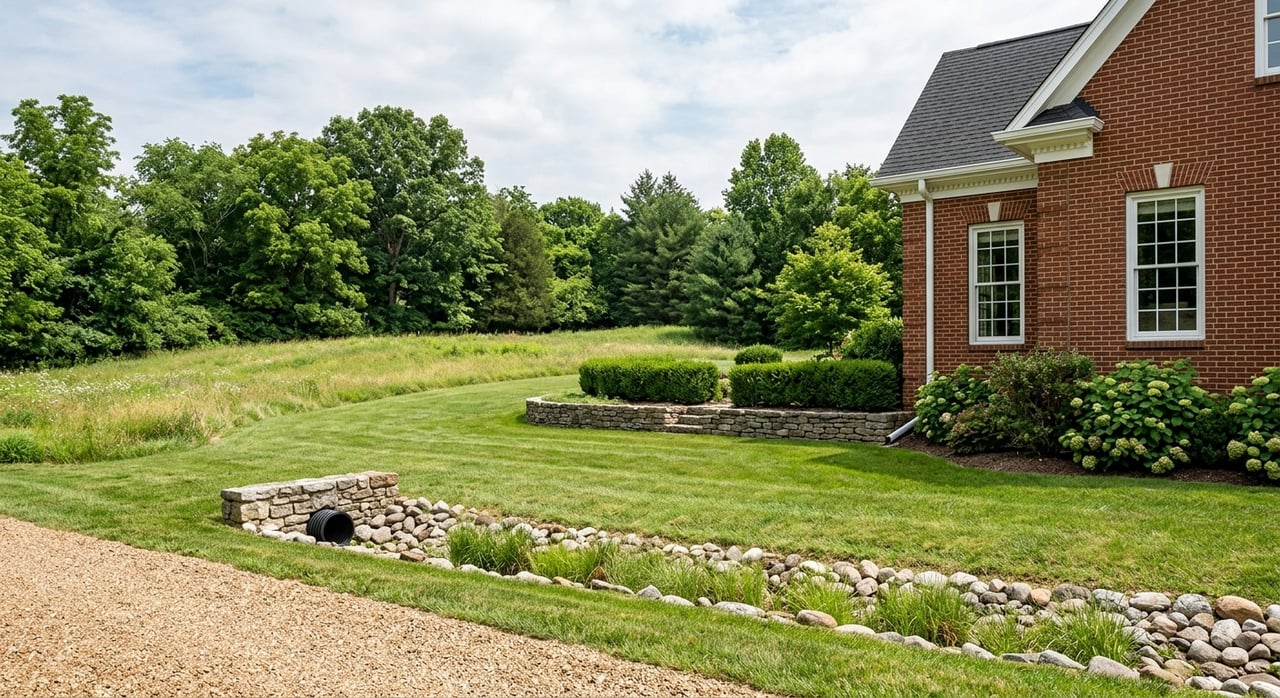
Land-focused purchases should always include a look at drainage and flood risk. Montgomery County regulates development in floodplains through Floodplain District permits, and the county makes clear that its maps are only a general guide.
For official public flood hazard information, the county points buyers to FEMA’s Flood Map Service Center. If a parcel includes low-lying ground, stream frontage, or areas that appear wet after rain, this step is especially important.
You should also ask whether the property has any stormwater management facilities. If it does, Montgomery County says the owner must have an easement or right of entry plus a maintenance agreement, and those documents are recorded in county land records. More detail is available through the county’s stormwater easement information.
In Dickerson, sheds, barns, detached garages, and similar structures can be a major part of a property’s value. They can also create questions about permits, placement, and allowed use.
Montgomery County states that permits are required before constructing or modifying many residential accessory structures, including detached garages, sheds, barns, gazebos, pool houses, portable storage, and sea containers. The county also notes that residential accessory structures must be in the rear yard.
For bona fide farm properties, the rules can differ. County guidance explains that a building used exclusively for agriculture on land used exclusively for agriculture may be exempt from a county building permit, though required electric, well, and septic permits may still apply. That distinction matters if you are buying land with agricultural use in mind.
Some rural properties may be agriculturally assessed, which can reduce tax value if acreage and use requirements are met. Montgomery County explains in its agricultural FAQ that eligibility depends on acreage and use, and certain properties must meet income or ratio standards.
This is worth discussing before closing because tax treatment can change if the land changes out of agricultural use. In some cases, transfer-tax consequences and penalties can follow. If a property is being marketed partly on its favorable tax status, make sure you understand what supports that status and what could affect it later.
If you are looking at a land-focused purchase in Dickerson, these are the questions I would want answered early:
These questions are property-specific, and county resources make clear that general maps or assumptions are not enough. On this kind of purchase, good due diligence is not overkill. It is part of buying responsibly.
A Dickerson purchase often involves more moving parts than a neighborhood home on a standard lot. You may need to coordinate county records, title review, well and septic information, driveway questions, and land-use restrictions all at once.
That is where local experience makes a difference. If you are weighing a purchase in Dickerson or anywhere in up-county Montgomery County, James E Brown can help you look beyond the photos and focus on the questions that really matter for the property, the land, and your long-term plans.


Jim Brown is dedicated to helping you find your dream home and assisting with any selling needs you may have. Contact Jim today to start your home searching journey!